Marketing automation software automates repetitive, yet vitally important, marketing tasks.
Picture a growing marketing team juggling dozens of campaigns, drowning in spreadsheets and manual emails. Valuable prospects slip through the cracks as the team scrambles to follow up—and ROI suffers as staff focus on execution instead of strategy.
Marketing automation solves these challenges by automating tasks such as lead nurturing and campaign scheduling—giving your team clarity and time to focus on strategy rather than administrative work.
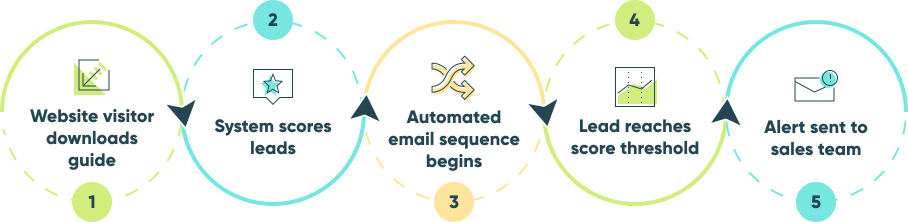

Top Five Capabilities of Marketing Automation
Manual marketing breaks down when teams juggle too many tools, too much data, and too many repetitive tasks. Marketing automation solves these challenges by unifying your most important marketing functions into one streamlined system. These five core capabilities form the foundation of effective marketing automation:
Workflow automation
Workflow automation helps you define each step in your marketing process and automatically trigger the next action as soon as an action is completed. With this, teams can streamline complex processes without losing visibility or control:
- Handle hundreds of daily tasks automatically
- Track progress from drafts through approvals
- Keep the team aligned without being overwhelmed
CRM integration
CRM Integrations keep your marketing and sales teams connected through a unified, always-updated lead database. This seamless data flow lets you plan and execute campaigns within your CRM.
- Automatically add prospects to nurture sequences
- Update lead scores continuously
- Transfer engagement history automatically—no manual entry
Lead capture and scoring
Lead capture and scoring ensure every prospect enters your marketing system with clean, reliable data and is evaluated and scored based on real engagement. This helps you prioritize the leads most likely to convert.
- Capture structured lead data via forms and landing pages
- Highlight sales-ready leads
- Focus your team on the best opportunities
- Assign points for key actions (e.g; pricing page + 10 pts, guide download = 15 pts)
Analytics and reporting
Analytics and reporting turn engagement data into clear insights so you can see what’s working (and what’s not). Live dashboards help you optimize your campaigns quickly and intentionally.
- Track email, channel, and message effectiveness
- Identify what drives conversions
- Optimize marketing spending with continuous data
Multi-channel coordination
Multi-channel coordination centralizes your messaging across email, social, SMS, and the web. It ensures customers experience consistent, cohesive communication everywhere.
- Connect email, social media, SMS, and web
- Ensure consistent messaging at every touchpoint
- Eliminate juggling multiple tools and logins
Top Benefits of Marketing Automation
These key functions transform how you work together to transform how your team plans, executes, and optimizes marketing. Here’s how marketing automation turns them into measurable, day-to-day benefits:
Streamline campaigns
Manual campaign management drains time and introduces errors. Marketing automation transforms how you execute by:
- Reducing manual work: Campaigns run automatically after initial setup
- Speeding up execution: Deploy campaigns in hours instead of days
- Improving collaboration: Up-to-date progress visibility for entire teams
- Enabling scalability: Manage more campaigns without adding headcount
- Standardize lead capture: Forms and landing pages automatically feed clean data
Nurture leads
Marketing automation creates consistent, personalized customer journeys tailored to each lead’s position in your funnel. Instead of manually capturing and tracking hundreds of prospects, the software does:
- Ensure complete records: Every new lead is captured with key details needed for scoring and segmentation.
- Consistent follow-up: Every lead receives timely, relevant content automatically
- Personalized experiences: Messages adapt based on behavior and engagement
- Effortless scalability: Nurture thousands of leads simultaneously
Improve your ROI
With instant insights and all your campaigns in one place, marketing automation delivers measurable financial impact with:
- Better resource allocation: See which efforts drive results in investing your time more effectively.
- Lower cost per lead: Less manual effort per prospect, while personalization improves conversion rates
- Time savings: Less administrative work, more strategic focus
- Data-driven decisions: Instant analytics show what’s working (and what’s not)
Marketing Automation vs. Manual Marketing Processes
The differences between automated and manual marketing go far beyond convenience. They directly influence efficiency, effectiveness, and ROI. Here’s how the two approaches stack up:
| With Marketing Automation | With Manual Processes | |
|---|---|---|
| Time required | Spend more time on strategy and creativity while campaigns run automatically. | Spend hours importing contacts and manually executing campaigns. |
| Personalization capability | Campaigns adapt based on behavior with personalized, timely messaging. (e.g., If a lead opens the email, send a follow-up in 2 days.” | Broad, generic campaigns that treat all leads the same. |
| Scalability | Handle 10x more leads without 10x more staff through automated workflows and response sequences. | More employees are needed to keep up with increasing traffic and move prospects through the funnel. |
| Human error rate | Messages are timely, consistent, and no lead is forgotten. | Employees oversee every message, increasing the risk of errors in follow-ups and missed opportunities. |
| Data tracking | Auto-populated analytics update live user engagement. | Teams manually pull data and continuously update reports. |
| Cost efficiency | Personalized, automated messages convert better while reducing the cost to nurture each lead. | Time equals money—staff spend more time on low-impact tasks, resulting in slower, more expensive growth. |
When you look at the two approaches side by side, the value of marketing software becomes undeniable. Strong systems, clean data, and automated workflows set the stage for more effective campaigns.
Get Started with Marketing Automation

For marketing teams of any size, automation unlocks greater efficiency, scalability, and clarity.
While advanced platforms handle campaign execution and nurturing, they rely on strong inputs—accurate lead capture, organized workflows, and clean data.
Cognito Forms offers a solid foundation with robust lead-capture tools that guarantee every prospect entering your system gets comprehensive, organized information. It also features built-in workflow automation that routes submissions, assigns tasks, and initiates follow-ups automatically.
When it’s time to transfer leads to your wider marketing environment, Cognito Forms easily integrates with leading CRM and marketing platforms such as HubSpot, MailChimp, and others, simplifying the process of moving leads into the tools you already use.

Miranda Peterson
Miranda is a Marketing Specialist at Cognito Forms who loves turning complex ideas into content that’s clear, helpful, and human. Outside of work, you can find Miranda enjoying local coffee shops, spending time in nature with her husband and two children, reading on her Kindle, or cooking for a group of friends.